
Lewis Andrews/ Landscapes
Lewis’s work acts as a conduit between art and science. The supply of information from science fuels the production of visual material, which communicates the knowledge of a scientific endeavour. In short, Lewis’s work focuses on dealing with complex thoughts, ideas and facts within nature and science. Some explore those in which we seem to be overshadowed and overpowered in comparison by the vast distances, size or quantities. Others investigate moments of extreme power, creation and rebirth on a molecular scale or on a scale comparable to that of the universe. Questioning our relationships, place and role within the universe, environment and natural spaces.
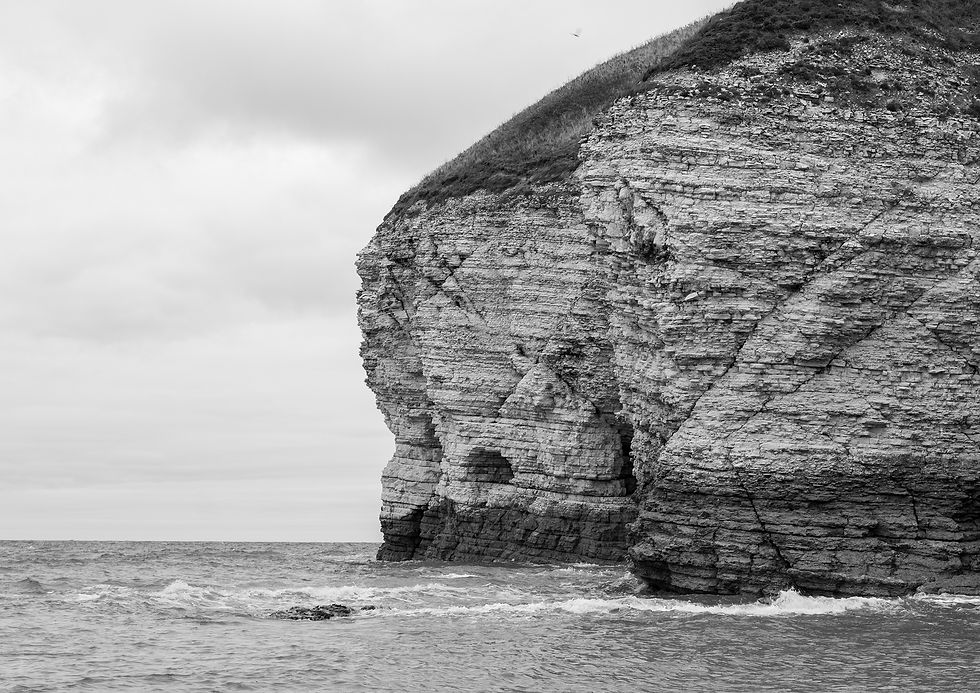
The ‘Ancient Periphery’ series of photographic works focuses on the cliff faces around Flamborough Head, a promontory approximately 8 miles in length on the Yorkshire coast in the UK. Primarily composed of chalk, the rock was formed over millions of years out of ancient marine organisms. This chalk appears in horizontal zig-zag layers, upon which is a layer of glacial deposits laid down during the last ice age by glaciers 18,000 years ago. Slowly but surely, over thousands of years, the sea has been reclaiming the cliffs from which they originated, as ancient marine organisms of life millions of years ago were buried beneath the waves. Through erosion due to the wind, waves, and high water line, the chalk’s weak points have become exposed, carving out the cliff faces, channels, caves, and jagged rock visually explored within the photographs. Standing upon the edge of the cliffs or beneath them as they touch the sea, there is a periphery between the land that has formed as a result of the sea over millions of years and the sea reclaiming them over thousands of years of erosion.


Comments